EN
EN  it
it

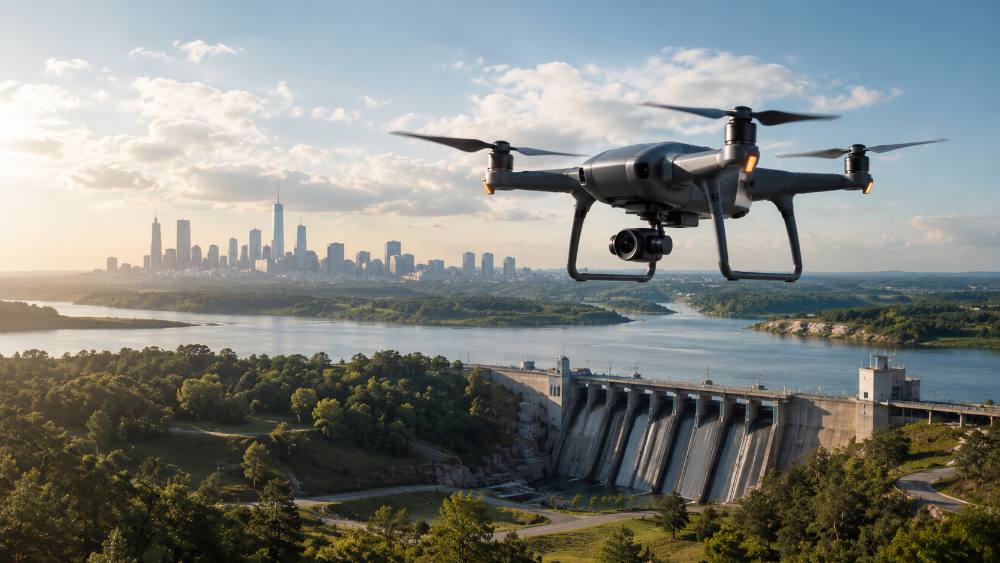
The civil drone market continues to grow, and above all it is consolidating itself as a technological infrastructure supporting increasingly complex industrial, territorial, and public processes.
According to the new Global Drone Market Report 2026-2035 by Drone Industry Insights, the global civil drone market will grow from $44.4 billion in 2026 to $83 billion by 2035, with an average annual growth rate of 7.2%. The forecast covers the civil market as a whole, including commercial, recreational and dual-use applications, while excluding military drones, counter-drone systems and passenger transport platforms.
For the professional supply chain, the data is significant because it captures a shift already underway: drone usage is no longer solely tied to the availability of platforms and sensors, but to the ability to integrate them into structured operational activities, from data collection to analysis, through to the production of technical outputs usable in decision-making processes.
Services, Hardware and Software: Where Value Concentrates
One of the most relevant elements of the report concerns the distribution of the market by segments.
In 2026, according to the infographic published by DRONEII, services account for 78.5% of the civil drone market. Hardware represents 17%, while software accounts for 4.5%.
Reading the data is clear: the sector’s value is heavily concentrated in activities that make the drone operational within a process. This area includes operations carried out internally by companies, services provided by specialized operators, system integration, engineering, consulting, training, simulation and education.
Software, while representing a smaller share in terms of market value, remains a central enabler: workflow, data analytics, fleet management, UTM, navigation and computer vision are increasingly critical components for scaling operations, standardizing procedures and making acquired data truly usable.
Construction, Energy and Agriculture among the Most Relevant Verticals
The report identifies construction as the leading vertical for commercial drone usage in 2026. This is followed by already established sectors such as energy and agriculture, where UAS use is linked to precise operational needs: surveys, monitoring, inspections, asset analysis and support for technical territorial management.
In construction, drones are used for mapping, surveying, work progress monitoring, monitoring of large areas and collection of geospatial data. In the energy sector, applications particularly concern the inspection of power lines, pipelines, turbines, offshore plants, refineries and infrastructure that is difficult to access. In agriculture, value is concentrated in the ability to acquire data useful for crop monitoring, water stress, vegetative variability and targeted management of interventions.
It is therefore not a generic growth in drone usage, but an evolution by application segment, in which each sector requires different combinations of platforms, payloads, operational skills, authorizations and data interpretation capabilities.
Mapping, Surveying, Inspections and Delivery
Among the main applications at global level, mapping and surveying stand out, followed by inspections, particularly when the use of the drone makes it possible to reduce intervention times, increase the frequency of checks and limit operator exposure in complex or potentially risky scenarios.
The report also highlights the growth of drone delivery, although still subject to significant regulatory constraints. The main areas of application concern healthcare, emergency services and logistics: transport of vaccines, medical samples, defibrillators, life-saving devices, parcels and food delivery.
The progressive maturation of these applications will depend on the ability to combine technical reliability, economic sustainability, operational authorizations and integration into airspace.
Regulation, Capital and Market Development
The growth trajectory indicated by DRONEII does not eliminate some structural criticalities.
The report highlights that regulatory obstacles remain among the main critical issues for the sector, particularly with regard to the evolution of BVLOS rules in Europe and the United States. Compliance costs and the slowness of authorization processes can limit the scalability of many commercial applications, especially in low-risk but high-frequency operations.
Access to capital, market development and acquisition of qualified customers also remain determining factors. The expected growth will not depend solely on available technology, but on the ability of companies to build sustainable, replicable business models that are consistent with the needs of different industrial and institutional sectors.
Global Data, Supply Chain Comparison at Dronitaly
The possibility of reading global trends through direct comparison among industry protagonists is an opportunity for development and growth for the entire supply chain: for this reason, the presence of DRONE Industry Insights among the Media Partners of recent editions of Dronitaly is particularly relevant for its community, made up of operators, companies, institutions, research bodies, public administrations and technical stakeholders.
In recent months, Dronitaly invited the community to respond to the Global Drone Industry Survey – an annual survey conducted by DRONEII on the commercial drone market. The sharing of some results of the Global Drone Market Report 2026-2035 offers Italian operators an updated reading of international dynamics, relating them to supply chain priorities: growth of services, development of professional applications, BVLOS operations, dual-use, software, AI, Big Data and specialized skills.
To consult the infographic and purchase the Global Drone Market Report 2026-2035, visit the DRONEII website: https://droneii.com/the-83-billion-drone-market-by-2035